The Rescue
In late 2016, Xentaurs had sold a Docker and cloud migration engagement to Liberty Mutual's Consumer business unit. The engagement was struggling—things weren't going well, and changes needed to be made. That's when they called me in.
Liberty Mutual was skeptical, to say the least. I had about three hours to prove myself or I'd be sent home. Fortunately, my first day coincided with their planning kickoff. That's when I took control of the room and started running sticky note Agile exercises to structure the work ahead.
The team was already convinced that Docker could give them a cloud-agnostic deployment strategy—that wasn't the issue. What they lacked was a concrete plan to get there. I provided that plan: Chef recipes to automate Docker Datacenter deployments, with Fusion built on top as the developer experience layer.
Part 1: Building the Fusion Platform
The foundation was Chef recipes that automated Docker Datacenter deployments—the infrastructure layer that made container orchestration possible at enterprise scale. On top of that, we built Fusion: a self-service automation platform that gave developers a clean interface for deploying into this infrastructure.
At the heart of Fusion was the "Fusionfile," a declarative configuration where teams could specify everything their application needed without understanding the underlying Chef or Docker complexity.
Fusionfile Capabilities
Upstream/Downstream Sidecars
Define service dependencies and communication patterns
Data Layer Components
MongoDB, Redis, RDS—declared, not requested
Pre/Post Deployment Steps
Custom execution hooks for migrations and setup
Self-Service Automation
Teams deploy without platform team involvement
The Fusionfile approach embodied the same philosophy I'd developed at Pearson and refined at Aetna: give developers self-service capabilities while the platform enforces operational best practices automatically.
Part 2: Containerizing the Enterprise
We started by containerizing three initial applications, including some challenging enterprise workloads. One notable success was containerizing IBM DataPower—not exactly the easiest thing to put in a container.
The Results by 2017
We also implemented Automated Virtualized Testing (AVT), which allowed teams to run integration tests against virtualized versions of their dependencies. This removed another bottleneck from the deployment pipeline.
Part 3: Teaching Cake Slicing
The Sr. Director of Cloud and Automation Engineering had two teams: one writing Chef recipes for the infrastructure layer, and another building Fusion for the developer experience. The problem? These teams were constantly dependent on each other. A single feature would take two sprints—one team would build their piece, then wait for the other team to build theirs.
I suggested "cake slicing" as a solution. Instead of organizing by technology layer (all Chef work on one team, all Jenkins/Fusion work on another), reorganize into cross-functional teams. Each team would have both Chef and Jenkins engineers, capable of delivering complete features end-to-end in a single sprint.
The Reorg: Layer Teams → Feature Teams
Before: Layer Cake
- - Team A: All Chef recipes
- - Team B: All Fusion/Jenkins work
- - Constant handoffs between teams
- - Two sprints per feature
- - Blocked waiting on dependencies
After: Cake Slicing
- - Team A: Chef + Jenkins engineers
- - Team B: Chef + Jenkins engineers
- - Each team delivers complete features
- - One sprint per feature
- - No cross-team dependencies
The principle applies beyond this specific case: organize teams around delivering value, not around technology layers. When teams can deliver complete, working features without waiting on other teams, velocity increases dramatically.
Key Lessons
Rescue Through Structure
Chaotic projects need immediate structure. Sticky notes and Agile techniques can realign a team in weeks.
Declarative Configuration
The Fusionfile pattern—teams declare what they need, platform figures out how—scales to hundreds of services.
Slice, Don't Layer
Deliver complete vertical slices of functionality. Value flows faster when features work end-to-end.
Docker Case Study
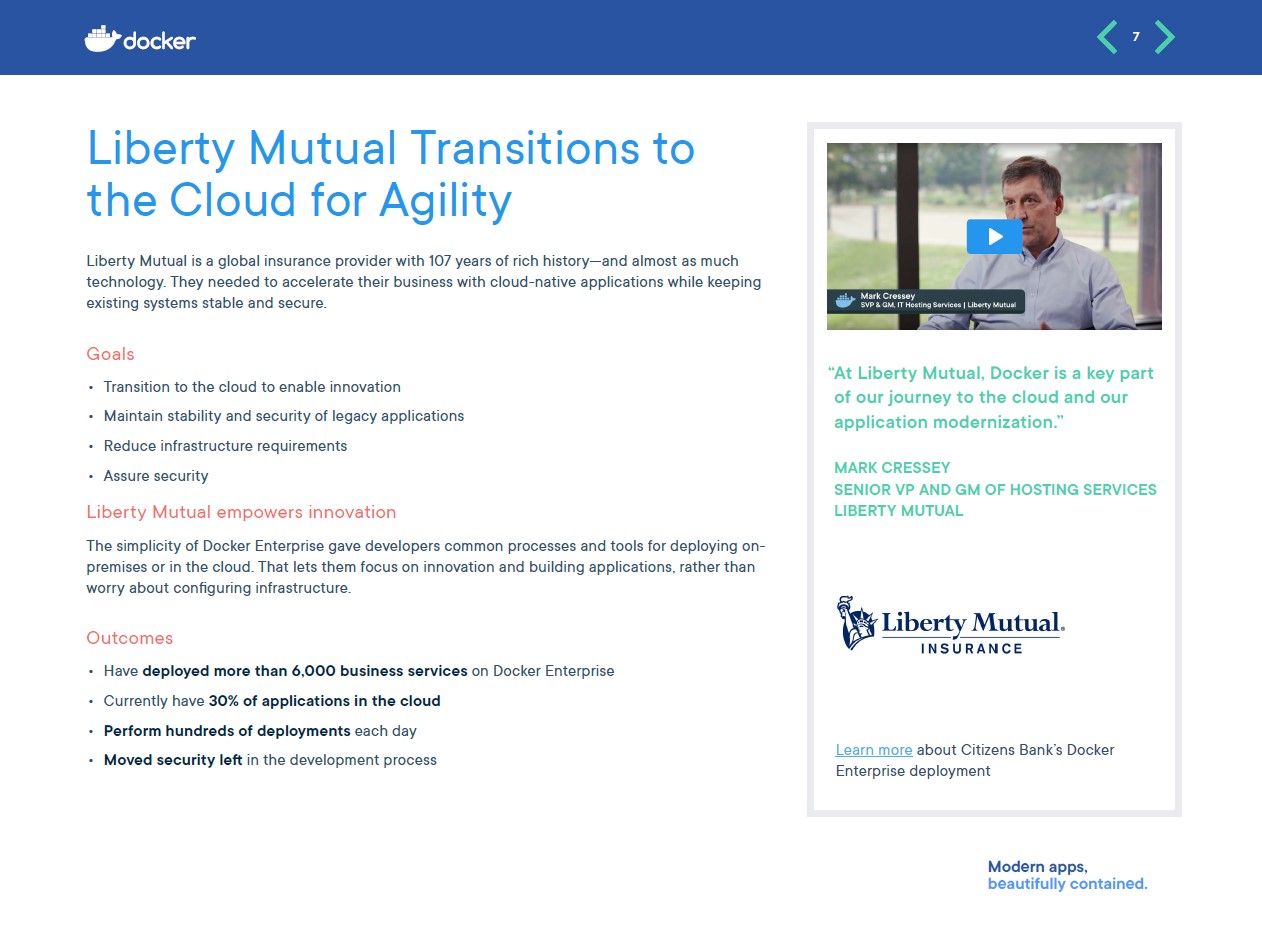
Liberty Mutual's containerization success was featured as an official Docker case study, highlighting the transformation from a struggling migration to an enterprise-scale platform.